
Showing a Friend from Abroad Around Okinawa: How Naha Changes from Morning to Night, and Where Street Kart Fits In
Showing a Friend from Abroad Around Okinawa: How Naha Changes from Morning to Night, and Where Street Kart Fits In
When a friend lands at Naha Airport, the first thing they say is usually one of two things: "It's hot" or "The ocean is the wrong color." "Wrong" is meant as praise. The blue sky opens up overhead the moment you leave the arrivals lobby, and the sea you glimpsed through the window is a greenish blue. To them, it looks like an edited photo. As soon as the automatic doors open, the humid air settles on your skin. That heaviness is how you know you've arrived.
A day of exploring Okinawa together is shorter than you'd expect. Between getting around, eating, and taking photos, the shadows are already getting long. So if you're the guide, the question to think about isn't so much "what to show" as "when to show it." Kokusai Street in the morning and Kokusai Street at night are two different streets. The sea at Senaga Island looks one color while the sun is high and another as it starts to go down.
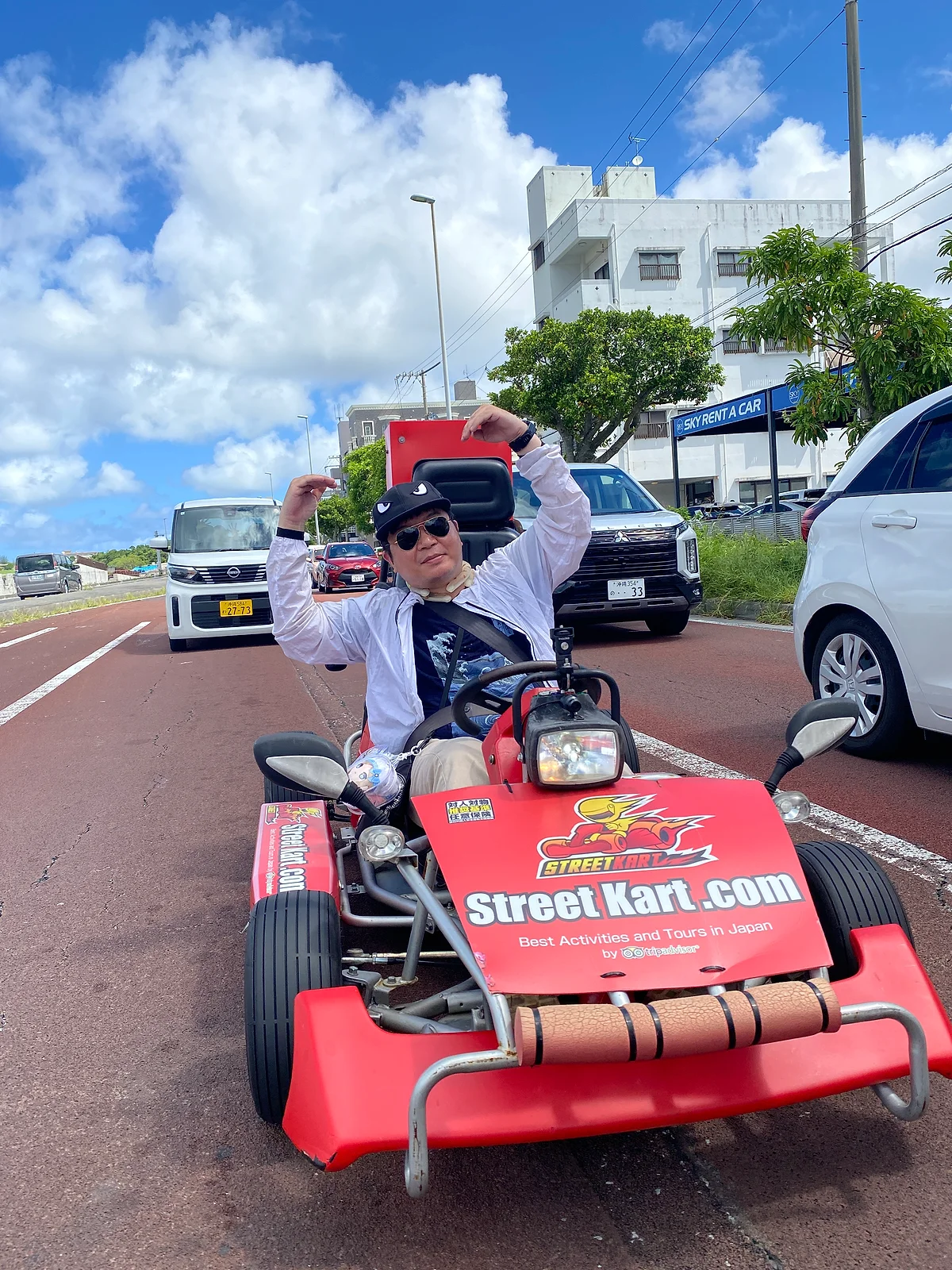
In this article, I'll go through a day based in Naha, one time of day at a time, and describe how the scenery changes. In the middle of the day is a kart tour with Street Kart. When you decide to get behind the wheel shapes how you spend the rest of the day.
The First Thing a Guide Should Decide: Make the Kart Slot the Anchor of the Day
Days in Okinawa go better when you plan them loosely. Still, there's one thing worth settling first: the kart booking.
The tours follow set courses decided by each store, led by a guide. A kart isn't something you can hop on and drive anywhere you like, whenever you like. Once your departure time is set, what to do before it and where to go after it fall into place on their own. If you leave that slot open, the day tends to just drift by.
Weekends book up quickly, so it's best to reserve early. If your friend's visit includes a weekend, it's a good idea to book as soon as their plans are clear. Check the official website for available time slots.
On the day, the tour is basically conducted in English, so a friend from abroad can understand the guide's explanations firsthand. Guidance in Japanese or other languages depends on the staff working that day and isn't guaranteed. If you need a language other than English, get in touch through the official website in advance so you can go in on the day without worrying.
Above all, check driving licenses first. Visitors from abroad have to meet certain conditions to drive in Japan, and which licenses and documents are valid depends on the country. Only original physical licenses are accepted. Digital licenses can't be used. You'll also need your passport for identification. If you don't have the required documents on the day, you won't be able to take part, and no refund will be given. Read the Street Kart official website together with your friend to confirm the details. Putting this off and running into trouble on the day is the most avoidable mistake there is.
Morning in Naha: Places to Walk Before the Crowds Arrive
Morning in Naha is quiet.
During the day, Kokusai Street is full of rolling suitcases and shop staff calling out to passersby. Early in the morning, though, there are only a few people around. You can see all the way down the street, and low sunlight falls at an angle across the silver shutters. This roughly 1.6 km street is known as the "Miracle Mile," and it's about a 10-minute walk from Street Kart's Okinawa store. If you get a feel for the street before it fills up, you'll notice the difference physically when you come back to the same spot later.
Makishi Public Market is also about a 10-minute walk from the store. Your friend will probably stop in their tracks at the colors of the fish on display: blue, red, yellow, wet scales gleaming on the ice. You might even get a look that says, "People really eat these?" On the market's second floor, restaurants will cook what you bought downstairs, so it's a good place for breakfast.
If you're up for a bit more walking, head to Yachimun Street (Tsuboya), about 15 minutes from the store on foot, lined with pottery shops. When the soft morning light hits the pottery, you can clearly see where the glaze has pooled and how the color varies. This time of day, before the sun is directly overhead, is also good for photos. Long shadows bring out the curves of the pottery and the texture of the street.
Walking these areas in the morning gives your friend a rough mental map of Naha. Later, when they see the same street from a different angle, they'll realize, "Oh, that's where we were earlier." Travel memories stick through overlaps like these.
Daytime: Plan Around the Strong Sun
Midday in Okinawa means intense sunlight.
The light doesn't just shine on you. It stings. Looking at a white wall hurts your eyes. Sunscreen, a hat, sunglasses, water: none of these are just "nice to have." You'll really miss them if you don't bring them.
For what to wear and bring on the tour, follow the guidance on the official website. All I'll say here is that if you're driving at midday, be ready to sweat. As the guide, part of your job is pacing things so you don't walk too much in the morning and run out of energy before the kart. Don't overdo it. Go at a pace that suits you both.
You could also use the daytime to visit Shurijo Castle. It's about 20 minutes by car from the store. It was the royal palace of the Ryukyu Kingdom and is a UNESCO World Heritage Site. A fire broke out in 2019, and restoration is still underway. The areas open to visitors change over time, so check the latest status before you go.
Note that you can't take the kart to Shurijo Castle. Tours only run on the courses set by the store. You'll need other transportation to reach places like this, before or after your tour.
Daytime is also when the blues of the sky and sea come out deepest in photos. On the other hand, the overhead sun tends to cast shadows straight down on people's faces. When you take photos of each other, ask your friend to tilt their hat brim up a little or stand right at the edge of a building's shadow, and their eyes will come out clearly.
Late Afternoon: Watching the Sea Change Color at Senaga Island
In the late afternoon, the colors of Okinawa start to shift.
Senaga Island is a small island just south of Naha Airport, about 15 minutes by car from Street Kart's Okinawa store. It's home to Senagajima Umikaji Terrace, a cluster of white buildings with views that feel like a Mediterranean resort. As the sun begins to sink, the white walls take on a faint orange glow. The sea, emerald green during the day, gradually turns a deeper color. The sound of the waves is the same as at noon, yet just the change in color makes the whole scene feel different.
Planes take off and land very close to the island. The roar of the engines reaches you a moment late and rumbles deep in your stomach. Looking up at a plane flying low over the water, your friend might laugh and say, "I was on one of those just this morning." The place where the trip began has become part of the evening scenery. That feeling stays with you longer than any photo.
Senaga Island also has Blue Seal, the ice cream brand Okinawa is known for. After a long day on your feet, eating ice cream in the sea breeze, even the speed it melts at feels tropical. Take your trash with you or put it in the designated bins. Enjoy the seaside view, then leave it the way you found it. Living near the ocean, that's something you just learn to do.
Whether you'll see the sunset, and when it goes down, depends a lot on the season and the weather. Summer and winter are completely different, so check the day's sunset time on a weather app before heading out. Even on cloudy days, there can be a moment when rays of light break through and fall on the sea. It's worth waiting until the sky gets dark.
Naha at Night: A Different Kind of Light
Once the sun sets, Naha's light comes down from the sky to street level.
Kokusai Street is lined with the lights of souvenir shops and restaurants, and it becomes something else entirely from the quiet street of the morning. If your friend walked it earlier, they'll notice: "It's the same place, but…" Signs that were just colors in the daytime are now lit up, crowds are moving, and the sound of a sanshin drifts out from a shop somewhere. Showing them both morning and night really drives the difference home.
For dinner, Okinawan food around Kokusai Street is an easy choice. Options include Urizun for Okinawan cuisine, Tondo for ramen, and Okashi Goten, known for its purple sweet potato tarts. Opening days and hours can change, so check each place's information before you go.
Night photos are tricky because the contrast between light and dark is so strong. If you expose for the signs, people come out dark. If you expose for people, the signs blow out to white. Use your smartphone's night mode, or have your friend stand where the light from a bright shopfront falls on their face, and you'll both come out looking natural. On crowded streets, it's also good manners to angle your shots so other people's faces don't fill the frame.
How the Time You Drive Changes the Okinawa You See
The differences between times of day that I've described so far happen on the kart, too.
The scenery on the Okinawa store's tours includes Senaga Island, the Kokusai Street area, central Naha, the area around Naha Airport, and roads along the coast. While the sun is high, the blues of the sea and sky are vivid. As the sun goes down, the white buildings and the surface of the sea change color moment by moment. After dark, the city lights take center stage. Check the official website to see which time slots are available, and choose based on the scenery you both want to see.
Check the official website for the latest routes. Courses are set by each store, and tours are led by a guide.
One more thing about safety. While driving, focus on steering. Picking up your phone or trying to photograph the scenery while driving is dangerous. Follow the staff's instructions on the day regarding photography rules. At night or in strong sunlight, things look different than they do during the day. Listen carefully to the lead guide's instructions and don't push yourself. You'll have plenty of time for photos before and after the drive.
What Makes Street Kart Appealing
How should you explain Street Kart to a friend you're bringing along? Here it is, point by point.
First, the tour is basically conducted in English on the day, so a friend from abroad can hear the explanations directly from the guide.
Second, a trained guide leads the way. Even a friend driving on Japanese roads for the first time simply follows the guide in front.
Third, the karts are single-seaters. If you go as a pair, each of you gets your own steering wheel. Instead of one of you watching from the passenger seat, you both see the same scenery from the driver's seat. When you talk about the trip later, each of you can tell it from your own point of view, which is more satisfying than you'd expect.
Fourth, the feeling of riding. You're close to the ground and the wind hits your face directly. The engine's vibration comes up through the seat, and the sounds of the city and the smell of the sea reach you unfiltered. Catching the scent of the ocean with your hands on the wheel somehow makes your memory of Naha's roads that much deeper.
Fifth, the Okinawa store's courses include classic Okinawan scenery like Senaga Island, the Kokusai Street area, and coastal roads. For a friend who has just arrived, it's a great combination for showing them what Okinawa is like.
Sixth, the track record. As of November 2023, across all stores, Street Kart had run more than 150,000 tours for more than 1.34 million customers, with an average rating of 4.9 out of 5. There are 9 stores nationwide (7 in Tokyo, 1 in Osaka, and 1 in Okinawa). The only place to ride in Okinawa is the Naha store.
Seventh, the website is available in 22 languages. Check the official website to see if it supports a language your friend can read.
Capturing the Day as a Pair
A common problem with photos from trips for two is that only one person ends up in them.
As the guide, you tend to end up behind the camera, but before and after the kart tour is a chance to get photos of the two of you together. If you arrive a little before the meeting time, you can take them without rushing. Ask the staff on the day whether it's okay to take photos with the karts around the store.
It also helps to give your photos a different role for each time of day. In the morning, shoot places like streets and markets. At midday, capture the colors of the sky and sea. In the late afternoon, catch the changing light, and at night, the city lights and your faces. Line them up, and the flow of the day becomes an album on its own. When your friend looks back at them after going home, they'll know right away when you did what.
When taking photos on a trip, be mindful of the people around you. At the market and on Kokusai Street, shop staff and other tourists may end up in your shots. Ask before photographing a shop's merchandise. If someone's face would take up a big part of the frame, change your angle. At the beach, don't go into restricted areas just to get a shot. These are all common sense, but they're easy to forget when you're caught up in the moment, so it's good for the guide to keep them in mind.
What to Check Together Before Booking
Finally, here are the things the two of you should talk through before booking.
First, driving licenses. Check the official website together to see whether your friend's license from their home country allows them to drive on public roads in Japan, and what documents they need. As the guide, don't settle for "it's probably fine."
Second, the tour format. Check the official website for how many people are in a group and how groups are put together, so nothing catches you off guard on the day.
Third, getting there. The store has no parking, so use public transportation or a taxi, and leave plenty of time. Hyatt Regency Naha Okinawa is nearby, about a 5-minute walk away.
Fourth, cost. Prices vary by season and time slot, so check the latest rates on the official website (kart.st).
Bookings are accepted via Facebook, LINE, and email. Contact details are on the Street Kart official website. Weekends fill up fast, so once your friend's dates are set, it's best to book early.
In Okinawa, the light changes as the day goes on: quiet morning streets, a midday blue so bright it hurts your eyes, the sea at dusk as its colors fade, and the evening lights coming down to street level. Put a time behind the wheel somewhere in there, and your day has an anchor. Start by talking with your friend about which light you'd like to drive through. They'll go home remembering even how warm the wind felt.
This article was originally written in Japanese and translated using AI. Some expressions may read unnaturally, and we appreciate your understanding. For the most accurate and up-to-date information, please refer to the official site at kart.st.
Street Kart is not affiliated with Nintendo or the Mario Kart series in any way. We do not provide costumes of Nintendo characters, and such costumes may not be worn during tours even if brought by participants.