
Seeing Everyday Life Between Naha's Sights at Different Times of Day: Walking the Market and Pottery Street, Then Riding a Street Kart
Seeing Everyday Life Between Naha's Sights at Different Times of Day: Walking the Market and Pottery Street, Then Riding a Street Kart
A bicycle with shopping bags hanging from the handlebars rolls slowly past the souvenir shops on Kokusai-dori. The plastic bags rustle with a dry sound each time they sway. A little farther on, a shopkeeper sprinkles water on the pavement and sweeps the storefront with a broom. Only the wet patch of asphalt has turned a shade darker. In Naha, ordinary daily life shows itself plainly in the gaps between the famous spots. The same street can look different depending on the time of day. If you're two people touring Okinawa on a tight schedule, passing through the same place at different times may stay with you longer, in memory and in photos, than adding one more landmark to the list.
Naha's "In-Between" Spaces Appear When You Shift the Time
Naha is far more compact than you might expect. Street Kart's Okinawa store is in Naha City, and according to the materials, it takes about 10 minutes on foot from the store to Kokusai-dori or the Makishi Public Market, about 15 minutes to Tsuboya Yachimun-dori, and about 20 minutes to Naminoue Beach or Tomari Iyumachi. Before or after your kart ride, you can find scenes of local life within walking distance.
One honest note here: this article won't say exactly what you'll see at what time. The strength of Okinawa's sunlight and the angle of the sun change a lot with the seasons, and opening hours vary from shop to shop. Any beach can look like a completely different place in summer and in winter, and Naha is no exception.
So instead of a timetable, here's a way of looking. The hours when shops are still getting ready. The hours when the city is at its busiest. The hours when the sun drops and shadows stretch long. If you plan your walking route with these three in mind, the same Naha will show you three distinct faces. When there are two of you, one could photograph "the city getting ready" while the other shoots "the city after the crowds arrive." That kind of split could be a lot of fun.
Walking the City Before It Opens: Makishi Public Market and Yachimun-dori
Before the crowds build, the area around Kokusai-dori is different right down to how the light falls. Under half-raised shutters, a thin strip of sunlight reaches into the back of a shop. Every time a hand truck's wheels cross a seam in the pavement, there's a small clunk. In front of shops not yet open, goods are set out one by one. Nothing dramatic happens. Still, this sense that something is about to begin is a scene you'll almost never catch during the crowded hours.
The Makishi Public Market is known as "Okinawa's kitchen," a place lined with Okinawan ingredients. It's said that you can buy ingredients on the first floor and have them cooked for you on the second. It's a tourist attraction and a working kitchen for local life at the same time, and that overlap hangs in the air of the market aisles. If you want to take photos, it's good manners to ask before pointing your lens at goods or shop staff. This is their workplace, so remember to stand where you won't block the aisle.
Walk a bit farther and you'll reach Tsuboya Yachimun-dori. "Yachimun" is the Okinawan word for pottery. The street is lined with pottery shops and cafés, and the atmosphere feels far less dense than the bustle of Kokusai-dori. The glaze on the dishes displayed out front shifts color slightly as the angle of the light changes. The rough texture of the stone paving and walls. Only when you slow your pace by half do these details finally catch your eye.
Even if you find a piece you love, it's safer to buy it after your kart ride. Space for luggage on the karts is limited, and the store's lockers are meant for small items and aren't suited to large bags. Rather than heading out with something fragile in your arms, finish your ride and then come back to the street to choose. That order is kinder to the pottery and to you, and it also means walking the same street again at a different time.
Physically, walking around this area doesn't seem to call for any special preparation. That said, Okinawa's sun can be much stronger than people from mainland Japan are used to. You'll feel better heading out with a hat, sunscreen, and water. When you find shade, go ahead and rest. Walking at your own pace is best.
The Busy Hours and the Late Afternoon: Tomari Iyumachi and Naminoue Beach
As the sun climbs and the crowds grow, Kokusai-dori fills with shopkeepers' calls, the footsteps of passersby, and music drifting from storefronts. At this time of day, there's no need to force a search for scenes of everyday life. It feels more natural to capture the bustle itself in a single frame. Stand at the edge of the street and shoot the flow of people from a little way back. Put it beside your morning photo of shops getting ready, and you have a "before" and "after" of the same street.
If you turn toward the sea, there's Tomari Iyumachi. It's a fish market with eateries, and rather than feeling like a tourist spot, it still strongly carries the air of a workplace for people who handle fish. The vivid colors of the fish laid out on the counters. On the ice, scales catch the light one after another. It's a place where you sense how close Okinawa's sea is through food rather than scenery.
Naminoue Beach sits within Naha's urban area. You can swim there, and Naminoue Shrine is right nearby. A sandy beach suddenly opens up as a continuation of the city, and that closeness will appeal to anyone who enjoys spending time in nature. As the sun lowers, shadows on the sand slowly lengthen, and the blue of the sea takes on a different depth than at midday.
To enjoy nature with respect, the basic rule at the beach is to take your trash home with you. It's the outdoor principle known as "Leave No Trace": leave the place no messier than you found it. This isn't meant as a lecture. It simply means the next visitors, and the people who live there, can enjoy the place too. That's all.
Passing Through Naha by Street Kart: From Kokusai-dori to the Coast and Senagajima
Having walked the city, now drive through it by kart. This order is what this article most wants to get across.
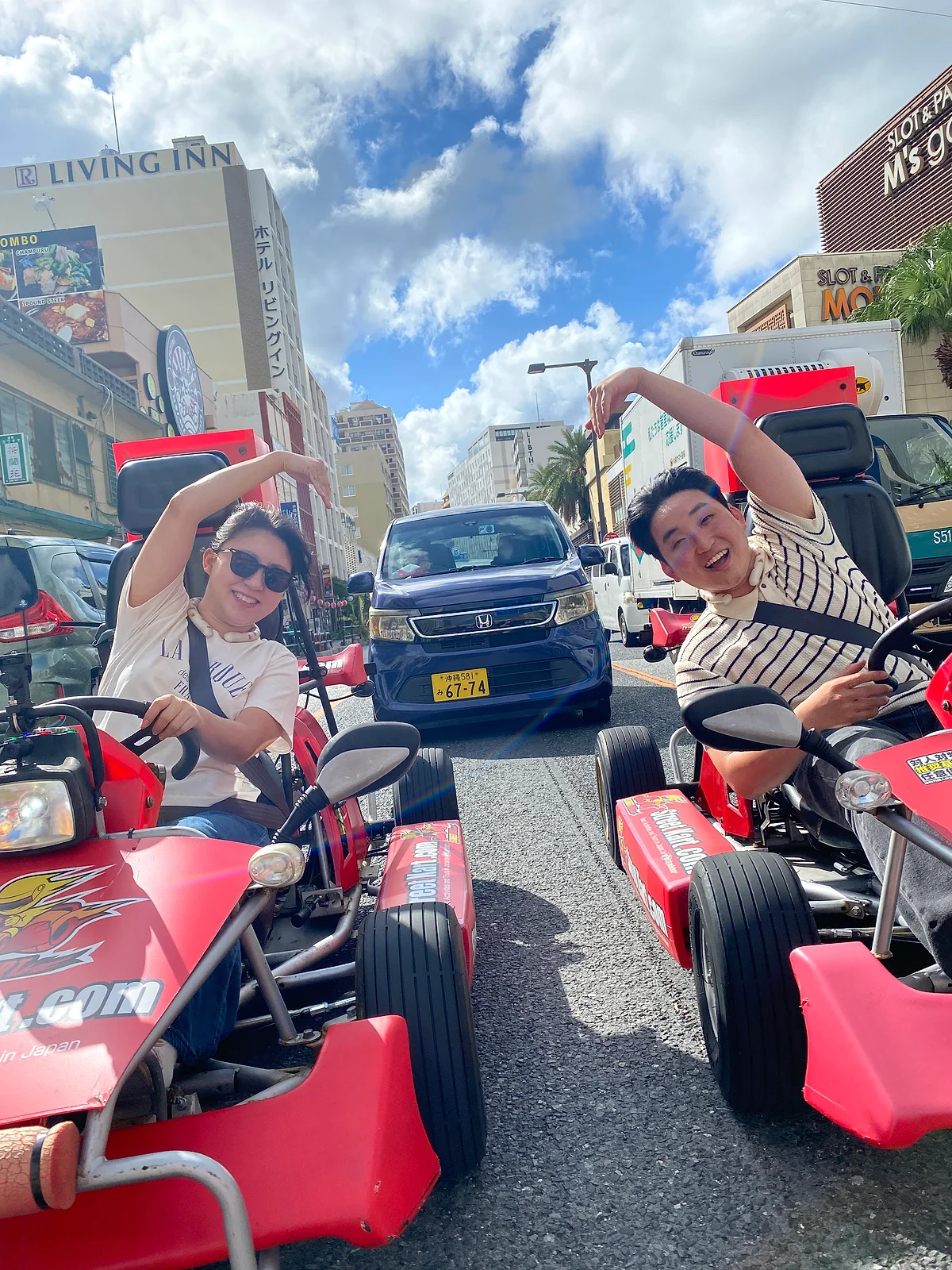
Street Kart's Okinawa tours follow a set route led by a guide. The places listed on the route in the materials include central Naha, such as Kokusai-dori, the area in front of the Prefectural Office, and Naha City Hall, along with coastal roads, the area around Naha Airport, and Senagajima. The actual roads may vary by tour, so please check the official website for details.
Before setting off, you'll check in at the store, have your driver's license verified, and receive a safety briefing covering how to operate the kart, the route, and important precautions. While listening, you can lay the streets you just walked over the map in your head, a pleasure that comes from doing things in this order. While driving, you follow Japanese traffic rules and the guide's instructions.
In central Naha, you'll see the Kokusai-dori area you walked earlier from a different height and at a different speed. The way the buildings line up and the width of the streets, things you didn't notice on foot, slip easily into your mind. When you reach the coast, the view opens up all at once, and where the row of buildings breaks off, the blue of the sea and sky rushes in. Around Naha Airport, you may see planes taking off and landing. The roar of an aircraft passing overhead will likely resonate right through your body.
Senagajima is a small island south of Naha Airport. It's home to Senagajima Umikaji Terrace, a shopping complex of white buildings, and the surrounding sea looks clear and emerald green. The materials mention that some courses include a break on Senagajima, and Blue Seal ice cream is named. Please check the official website to see which courses include a break. The island is also described as a place to watch the sunset, but sunset times shift with the seasons. If you're aiming for evening light, plan by matching it against the tour's time slots. Checking the official website is the surest way to confirm departure slots and times.
What Makes Street Kart Appealing
Here, let me sum up the kart itself, just once.
First, the sheer amount you take in through your body. Once you're moving, the wind hits your cheeks, the sound of nearby cars is right beside you, and the moment you reach the coast, the smell and humidity of the air change. It feels less like "looking at" the scenery and more like moving forward inside it.
Second, how well it suits two people traveling together. The karts are designed for one person, so each of you holds your own steering wheel. Rather than watching from the passenger seat, you both drive through the same scenery. After the ride, it's fun when your impressions of the same route differ a little.
Third, language. The website supports 22 languages. Guidance on the day of the tour is basically in English; guidance in other languages depends on the staff that day, so it can't be guaranteed. If you're concerned, try contacting them in advance through the official website.
Finally, just one figure on their track record. As of November 2023, the total number of customers across all stores exceeded 1.34 million, with an average rating of 4.9 out of 5. It's not a current figure, but it gives a sense of how many people have ridden so far.
If You Want Photos: Separate Time for Shooting From Time for Not Shooting
The most important thing about photos is not to operate your smartphone or camera while driving. Focus on driving during the tour, and follow the staff's guidance on when photos are allowed and what the rules are. The tour includes stops at photo spots. This is for safety, and also so you can properly take in the scenery. The coastal light you see with your own eyes, rather than through a screen, will stay with you far longer.
That's why it's a good idea to set aside plenty of time for photos before and after the tour. Kokusai-dori as shops get ready, the market stalls, the pottery on Yachimun-dori, the fish at Tomari Iyumachi, the sand at Naminoue Beach. Scenes of daily life like these are most naturally captured while walking.
A few shooting tips. One: photograph the same spot twice at different times. If you keep the same position and angle, the differences will stand out clearly when you put them side by side. The number of people, the direction of the shadows, how far the shutters are raised. Just two photos side by side can convey a day in the life of the city.
Two: under strong sunlight, white buildings and sandy beaches tend to get blown out. On a smartphone, tap the screen and lower the brightness a little before shooting, and the color of the sea and the outlines of buildings will come through better. On the other hand, once the sun lowers, the light softens and photos with people in them become easier to take.
If you're traveling as a pair, try photographing not only your partner's face but also their back as they gaze at the scenery. Even without a face in the frame, a shot like that can sometimes convey the very wind that was blowing at that moment.
Preparing to Make the Most of Limited Time Together
Booking early is the surest approach. Weekends fill up quickly, so it's best to reserve as soon as your dates are set. How to contact them for reservations is explained on the official website. Tour times, duration, and prices vary by season and plan, so please check the latest information on the official website (kart.st).
For driver's licenses, the required license types, the handling of International Driving Permits, and what to bring on the day are all spelled out in detail. Before your trip, make sure you can drive with your license by checking the official driver's license page. Finding out on-site that "you can't ride with this license" would be the most disappointing ending of all.
There's also one thing to note about getting to the store. The store has no parking, so public transportation is recommended. Please come by a means that doesn't involve driving yourself, such as the Yui Rail, a taxi, or walking from your hotel.
It's also worth giving your clothing a little thought. Closed-toe shoes, preferably sneakers, are recommended for riding the karts. Sandals, heels, skirts, and dresses are listed as things to avoid. In Okinawa, it's tempting to go light on footwear, but since you'll also be walking through the market and on stone-paved streets, it's easiest to just wear sneakers all day. In summer, a hat, sunglasses, and sunscreen are said to come in handy.
Keep the weather in mind, too. In light to moderate rain, tours run as scheduled, and raincoats are provided free of charge. In heavy rain or typhoons, tours are canceled, and options such as a shortened tour, rescheduling, or a full refund are offered. If you're traveling during typhoon season, leaving an extra day of slack in your schedule will give you some peace of mind.
How you plan your day should depend on the stamina and tastes of the two of you. If you love walking, visit the market and Yachimun-dori before the tour and Naminoue Beach after. If you love food, work in Tomari Iyumachi or the market. You can also spend time at the sea before getting in a kart: spend the morning at the beach, shower and change, then head to the tour. Please don't come in a wet swimsuit; change into comfortable clothes before heading to the store. Whatever you choose, don't overpack your schedule. Rather than grinding through plans in the heat, leave some room so you can stop on a whim in a side street that catches your eye. It's in those gaps that scenes of everyday life appear.
Lining Up a Day in Naha With Your Own Eyes
Simply making the rounds of the sights is enough to enjoy Naha. Even so, if you turn your attention to what lies between them, the shopfronts getting ready, the market aisles, the street lined with pottery, the fish market by the sea, your trip comes into sharper focus. Walk the same street at different times, then pass through it again by kart from a different height. The light, sounds, and wind you gather that way should come back to you when the two of you look back on them, not as a mere record but as "Naha on that day," complete with the slightly damp scent of the sea.
Once your dates are set, start by checking tour details and departure slots on the Street Kart official website, then get in touch to book. If you plan to ride on a weekend, moving early will give you peace of mind.
This article was originally written in Japanese and translated using AI. Some expressions may read unnaturally, and we appreciate your understanding. For the most accurate and up-to-date information, please refer to the official site at kart.st.
Street Kart is not affiliated with Nintendo or the Mario Kart series in any way. We do not provide costumes of Nintendo characters, and such costumes may not be worn during tours even if brought by participants.